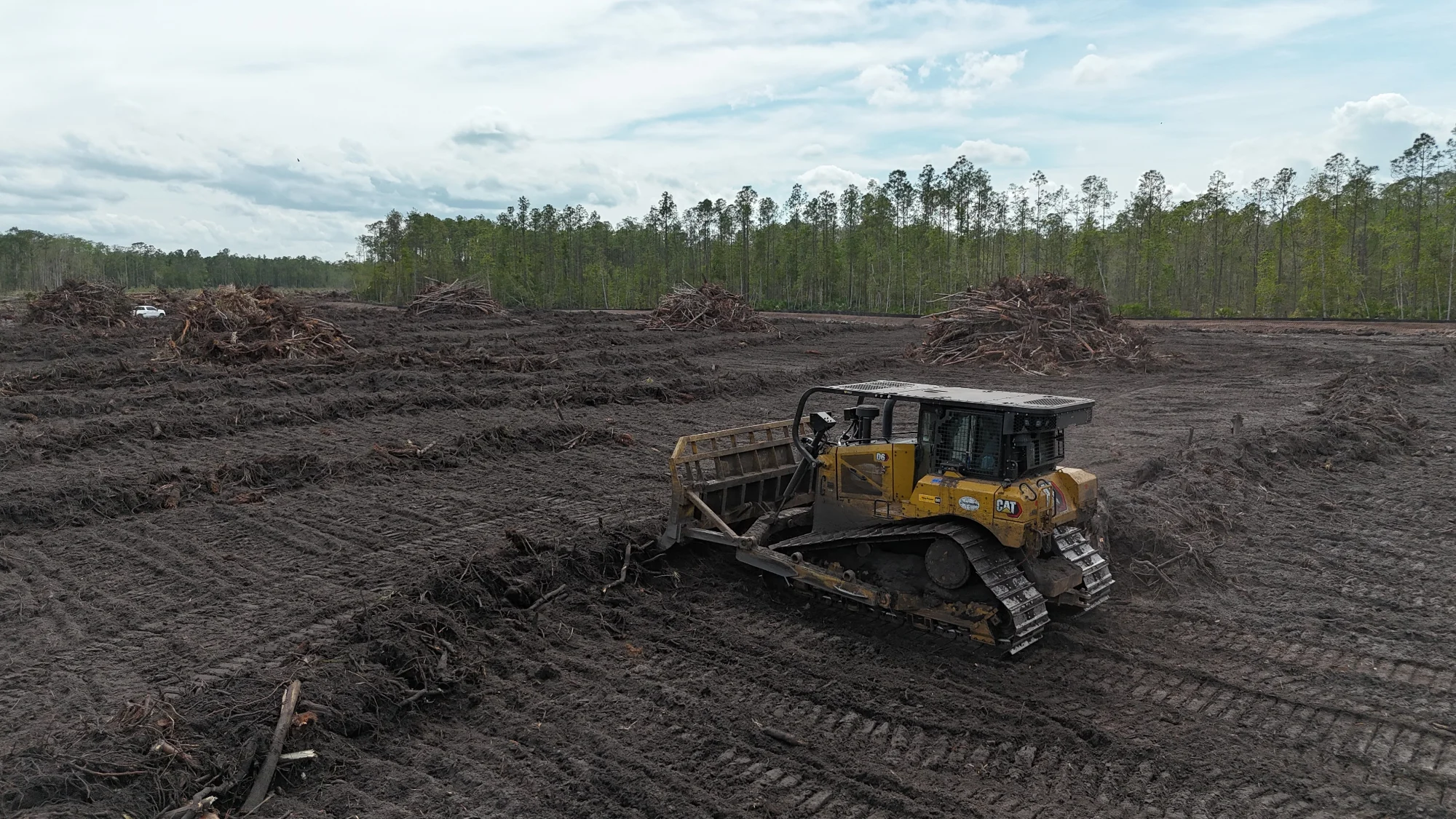
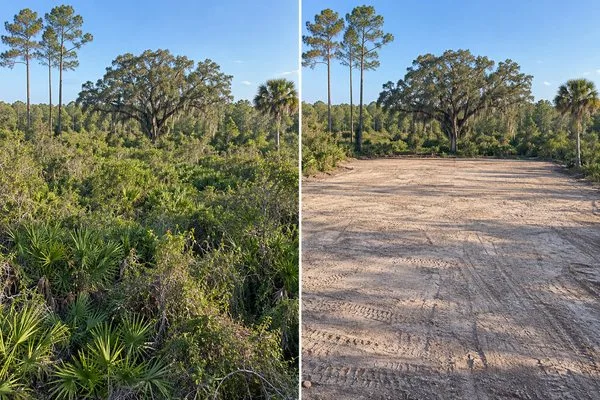
The best proof that a crew can turn raw acreage into a build-ready site is a site they have already finished. Before-and-after photos of real land clearing projects show you exactly what to expect, from the first pass with the machines to a clean, graded parcel.
That is why we put our work on display. When you are ready to talk about your own parcel, reach out to our team or call (407) 732-4530.
What kinds of land clearing projects are in our completed work?
Our completed work covers the sites Central Florida developers deal with most: overgrown wooded parcels, lots choked with brush and debris, and land that has sat untouched for years.
Wooded parcels are some of the most dramatic transformations. Dense pine, oak, and palmetto can hide the shape of the land entirely, and clearing them reveals the actual footprint you have to work with.
Debris-choked lots bring a different challenge. Old dumping, fallen trees, and tangled undergrowth all have to come out before anyone can see the soil, let alone build on it. Hidden debris can also damage equipment or hold up grading if it is missed on the first pass.
Across the Orlando area, growth in places like Horizon West has turned former groves and woodland into active development sites. Seeing similar parcels cleared helps you picture what yours can become, and gives you a realistic sense of the work involved.
How does a site go from initial clearing to grinding and grading?
The process moves in stages. First, crews clear trees, brush, and stumps. Next, the debris is processed on site. Finally, the ground is shaped and leveled so it is ready for surveying, utilities, and construction.
Clearing sets the stage. Our land clearing crews remove vegetation and stumps while protecting any trees or areas the site plan says to keep. Marking those areas before work starts keeps the job aligned with your permits.
Debris comes next. Our grinding service processes cleared material on site, which is required on close-quartered jobs, right-of-ways, and any site where burning is not an option.
Grading finishes the transformation. Along the SR 417 corridor near Lake Nona, where commercial projects are moving fast, a level, well-drained site lets the next trades start right away instead of waiting on rework. Each stage builds on the last, so a clean clearing job makes grinding and grading go faster.
What does a cleared site help developers see?
A cleared site lets you and your partners see the land for what it is: where the entrance should go, how the building sits, and where parking and drainage will work best. Plans on paper finally match what is on the ground.
A developer once met us at his property with burrs stuck to his pants. He told us the place was so overgrown his partner could not picture where the entrance would be. After we cleared the brush, removed stumps, and graded the site, they could finally see where the parking lot and building would go.
That moment matters for decisions. Engineers, architects, and lenders all work faster when they can walk a clean site instead of guessing through thick brush.
In northwest Orange County near the Wekiva Parkway, where new commercial sites are opening up, a clear view of the land often speeds up design and approvals.
How do documented results de-risk vendor selection?
Documented results show you what a crew actually delivers, not just what they promise in a bid. Before-and-after photos let you judge how clean, level, and ready their finished sites really are.
Look for consistency across projects. A crew that leaves site after site clean and properly graded is far more likely to keep your construction timeline on track than one with only a polished sales pitch. Photos from different seasons and site types are a good sign the crew handles more than one kind of job.
Ask about the sites behind the photos too: how large they were, how long they took, and what challenges came up. Good answers show a crew that plans ahead. Vague answers usually mean the photos tell only part of the story.
Take a look at our work, then let us see yours. Call Drinkwater & Drinkwater at (407) 732-4530, or request a site evaluation for your Orlando-area parcel.