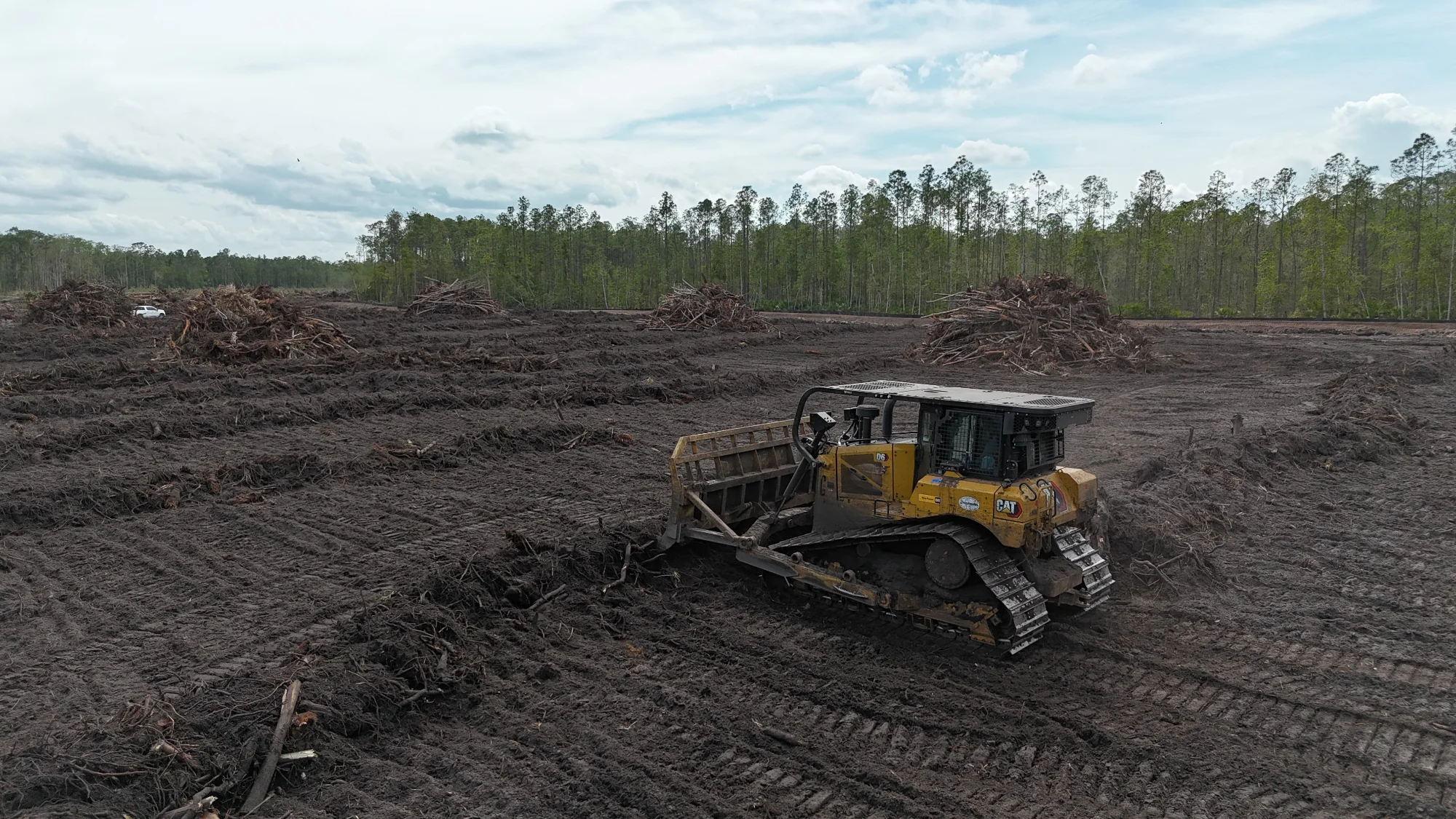
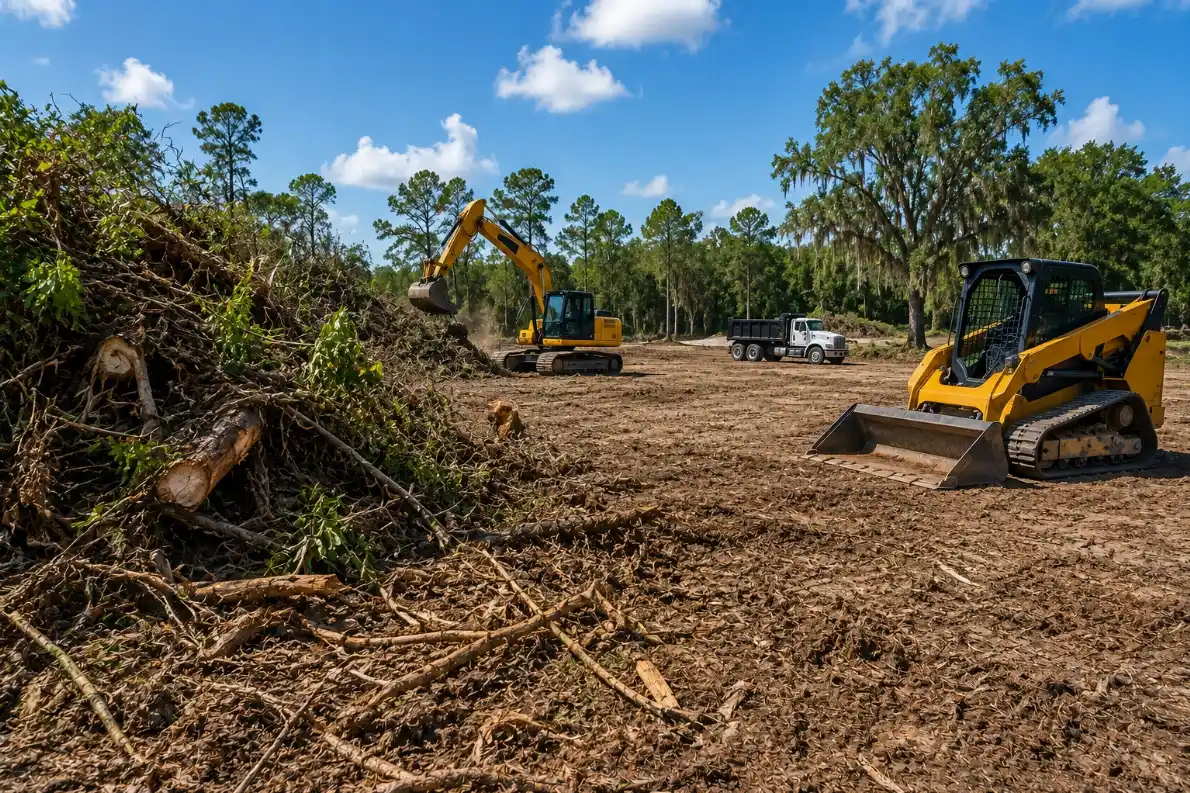
Land clearing cost in Sanford, Florida depends on acreage, vegetation density, stump removal, debris handling, permitting requirements, and how quickly the site must be ready. A lightly wooded parcel can require far less work than a dense site with large trees, heavy undergrowth, and extensive root systems. For a development near Historic Downtown Sanford, the only reliable way to establish a realistic budget is to evaluate the actual property.
Drinkwater & Drinkwater works with developers and homebuilders who need practical site preparation for Central Florida projects. If you are budgeting a property near the Sanford RiverWalk, call (407) 732-4530 and contact Drinkwater & Drinkwater to request a free on-site estimate.
A site near Fort Mellon Park may look straightforward from the road and still contain conditions that significantly affect production time and equipment requirements. Tree size, access, wet areas, existing structures, debris volume, and the amount of material that must leave the property can all change the final cost.
Acreage Is Only the Starting Point
Developers often begin with a price-per-acre question, but acreage alone does not tell you enough.
Ten acres of open, lightly vegetated property can require less labor and equipment time than three acres covered with mature trees, thick brush, vines, and large stumps. Density affects how quickly machinery can move through the site and how much material must be processed afterward.
When requesting a quote, expect the contractor to look at both total acreage and what is actually growing on it. The combination of those two factors provides a much more useful basis for estimating land clearing.
Access matters too. Tight entry points, neighboring development, overhead obstacles, and areas that cannot support heavy equipment may require a different approach and can increase production time.
Vegetation Density Can Move the Budget Quickly
A site with grass, small brush, and scattered trees is different from a heavily wooded parcel.
Larger trees take more time to remove and create more material to manage. Dense understory can slow equipment, while mature root systems may require additional work if the development plan calls for complete stump removal.
Before clearing begins, define what needs to remain. If there are trees, buffers, or other features that must be protected, identifying them early helps the contractor plan equipment movement and avoid unnecessary work.
The more precise the clearing limits are, the easier it is to build an accurate scope and reduce change orders.
Stump Removal and Debris Handling Affect Cost
Cutting vegetation is only part of the job. What happens to the material afterward can have a major impact on the budget.
One option is to remove stumps and haul vegetation away. That approach can involve loading, trucking, disposal, and additional equipment time.
Another option may be to process suitable woody material on the property through grinding. Depending on the site and development plan, grinding can reduce the volume of material that needs to be transported.
Ask what the proposed price assumes. Does it include stump removal? Is debris being hauled away or processed on site? How many loads are anticipated?
Two clearing bids can look very different simply because one includes debris handling and the other does not.
Permitting and Environmental Conditions Matter
Sanford development projects may be subject to site development requirements, clearing regulations, approved plans, environmental restrictions, or other permitting considerations depending on the scope.
The City of Sanford's land development regulations include requirements related to site preparation, excavation, and land clearing. That is why clearing should be coordinated with the project's broader development and permitting process rather than treated as an isolated task.
Wet areas, protected vegetation, drainage concerns, and required buffers can also affect how much of a property can be disturbed and how equipment moves through the site.
Your clearing contractor does not replace your engineer or permitting consultant, but an experienced Central Florida crew should know when site conditions require additional coordination before work proceeds.
Faster Is Not Always Cheaper
Schedule can change cost just as much as site conditions.
If a contractor has enough time to sequence equipment, hauling, and crews efficiently, the job may be easier to manage. An accelerated schedule can require additional crews, longer operating days, more trucks, or equipment dedicated exclusively to the site.
For developers, that does not automatically make rush work a bad decision. Sometimes spending more on clearing is justified if it protects a construction start date or prevents another trade from sitting idle.
The important question is ROI. Ask what additional cost is created by compressing the timeline and compare it with the cost of delaying the overall project.
Compare Clearing Bids by Scope, Not Just Total Price
A low bid can be misleading if it does not include the same work as the other proposals.
Before making a decision, compare:
- Total acreage and clearing limits
- Vegetation and tree density assumptions
- Stump removal requirements
- Debris hauling or processing
- Equipment and mobilization
- Access limitations
- Expected schedule
- Exclusions and possible additional charges
A more complete proposal may carry a higher initial number while reducing the risk of change orders later.
Developers should also ask what happens if field conditions differ from the assumptions used in the estimate. Clear communication around those variables is one of the best ways to protect the project budget.
Why an On-Site Estimate Is the Best Number
Online averages and generic price ranges can help with early planning, but they cannot account for the actual conditions on your Sanford property.
An on-site evaluation lets the contractor see vegetation density, tree size, access, terrain, debris volume, and other conditions that directly affect labor and equipment time. It also gives you an opportunity to explain the project schedule and what the site needs to look like when clearing is complete.
That information turns a rough allowance into a project-specific estimate you can use in your development budget.
For a realistic number based on your actual property, call Drinkwater & Drinkwater at (407) 732-4530 and request your free Sanford land clearing estimate.