Consolidating site preparation with one contractor minimizes scheduling gaps between services and makes the whole process smoother. When one excavation company handles clearing, grinding, and disking, each step starts the moment the last one ends, and you stop paying for days when nobody is on the site.
Drinkwater & Drinkwater works with Orlando developers and general contractors who want site prep handled by one crew from start to finish. To talk through your next parcel, reach out to our team or call (407) 732-4530.
How Do Gaps Between Subcontractors Stall a Schedule?
Every handoff is a chance for the job to stop. When the clearing crew finishes and the grinding crew is still on another site, your parcel sits idle, and the delay rolls forward into grading, utilities, and everything after.
Most developers have lived this. The clearing sub wraps up on a Thursday, but the grinding sub cannot come until the following week. Then the soil crew finds stumps that were missed and refuses to start until someone comes back. Nobody did anything terribly wrong, yet the site lost days.
The problem gets worse on busy corridors. A parcel off Interstate 4 with tight access may only allow one crew at a time, so a missed handoff means trucks and machines lined up with nowhere to go.
There is also the blame problem. When three subs touch the same ground, each can point to the others when something is off. You end up refereeing instead of running your project. One contractor owning the whole sequence takes that off your plate.
Why Does One Company With Its Own Fleet Keep Work Moving?
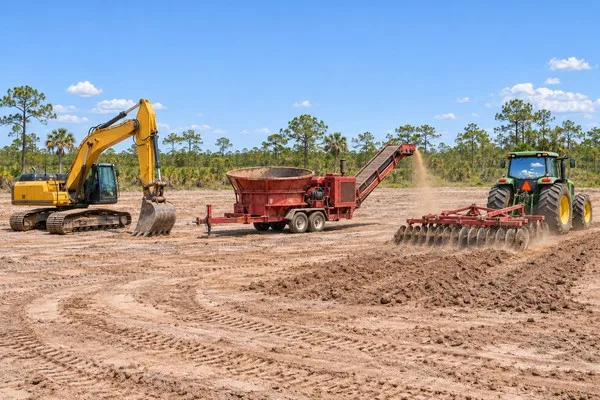
Because the next step does not depend on someone else's calendar. An excavation company with its own equipment and trucking can move from clearing to grinding to disking on its own schedule, without waiting for an outside crew to free up.
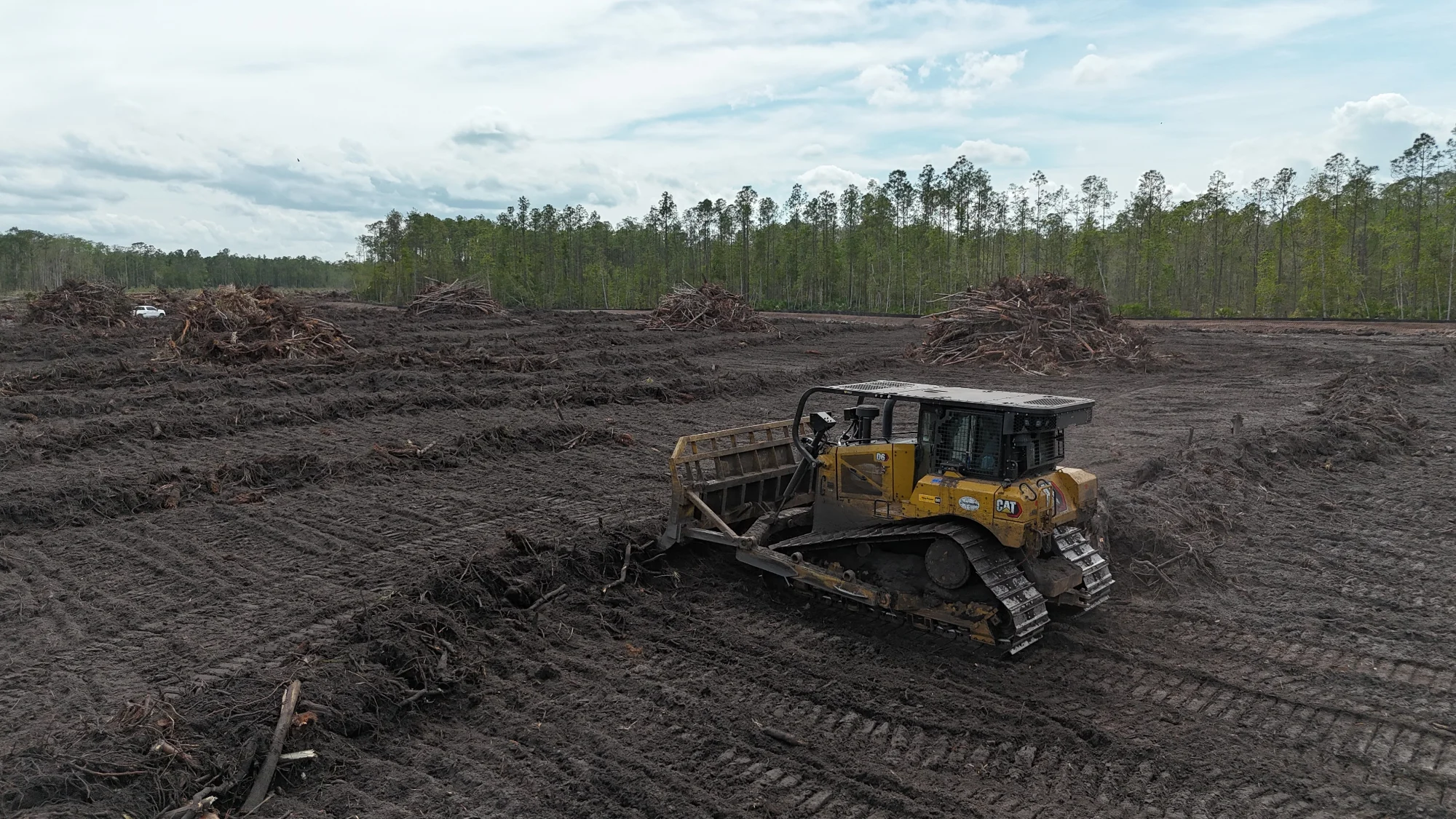
Owning the equipment means the right machine shows up when the work calls for it. If a section of the parcel needs more clearing than planned, the crew adjusts on the spot. If debris piles up faster than expected, our own trucks haul it out instead of leaving it to block the next phase.
Consider a large tract out toward Lake Nona, where wooded acreage turns into building pads. Our grinding work can follow right behind the clearing crew, so stumps and debris never sit long enough to slow the soil work.
From there, disking breaks up the top layer and leaves ground that is ready for grading. Three services, one plan, and no gaps you have to manage.
How Does a Single Point of Contact Cut Confusion?
You get one person who knows the whole job. Instead of tracking three project managers and three sets of updates, you talk to the foreman running your site, and that person can answer for every phase.
That matters most when plans change. Say the engineer moves a retention pond or a lot line shifts. With separate subs, you have to relay the change three times and hope everyone heard it the same way. With one foreman, the change is made once and carried through clearing, grinding, and disking.
It also makes daily updates simple. You call one number and hear where the site stands, what is happening tomorrow, and whether anything needs your attention. On a growing community in Horizon West, where builders are waiting on pads, that kind of clarity keeps everyone else on schedule too.
A single point of contact is also accountability. If something is not right, there is no question about who fixes it.
What Should You Ask About Capacity for More Than One Site?
Ask how many sites the contractor can run at once and how they split equipment and crews between them. A company that can only handle one job at a time may be a bottleneck once your pipeline grows.
Developers rarely have just one parcel moving. You might be closing on one tract while another is ready to clear. Before you commit, ask direct questions. How many crews does the company field? Does it own enough machines and trucks to keep two sites working without pulling equipment off one to serve the other?
Ask about past work as well. A contractor that has handled commercial parcels and multiple active sites should be able to show you. You can see examples of projects we have completed on our work page.
Finally, ask who your foreman will be on each site and how they communicate. Capacity is not only about equipment. It is about having experienced people leading every job you send their way.
If you are lining up your next parcel and want site prep handled by one crew, call (407) 732-4530 or contact Drinkwater & Drinkwater to schedule a site consultation.