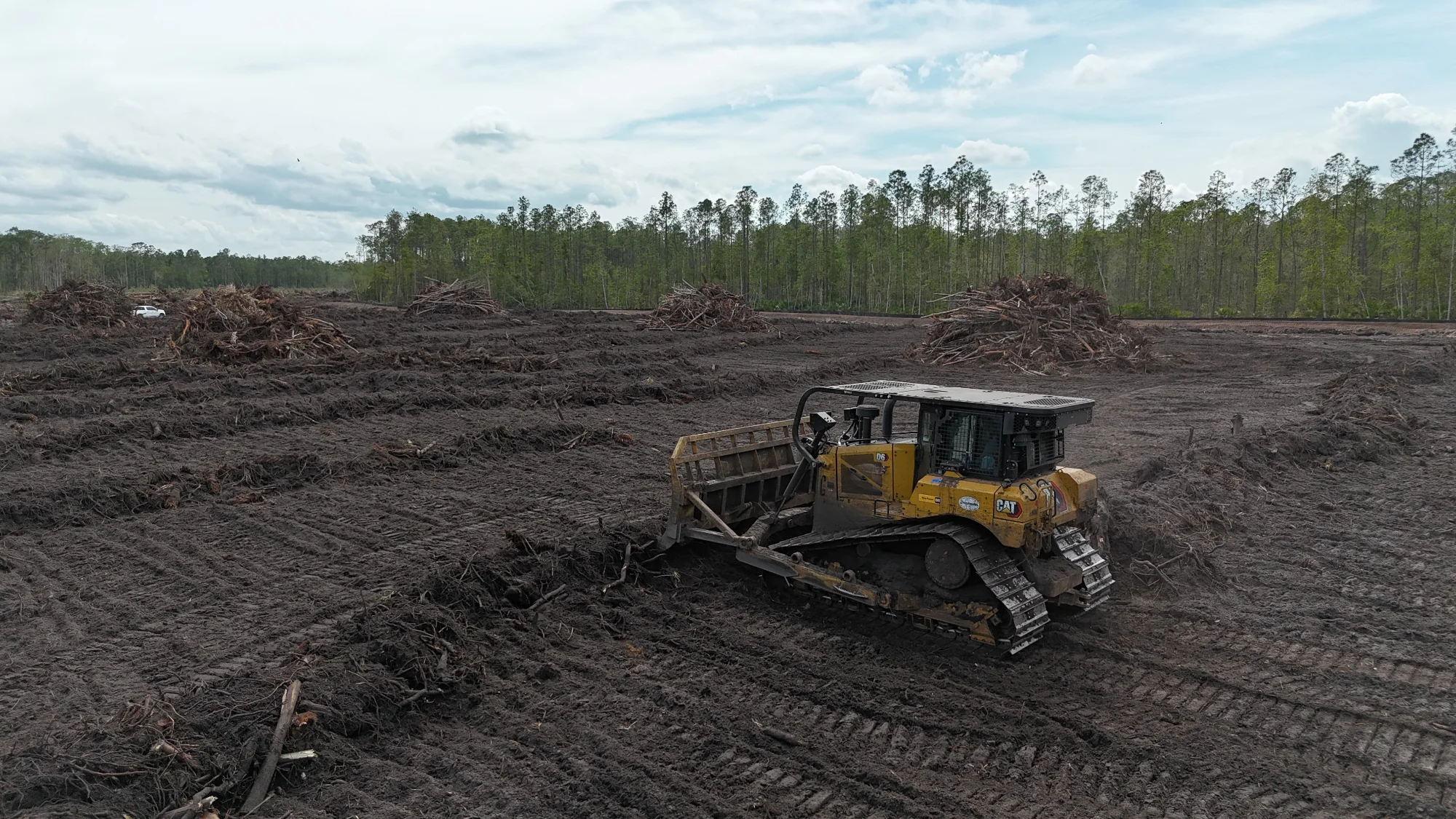
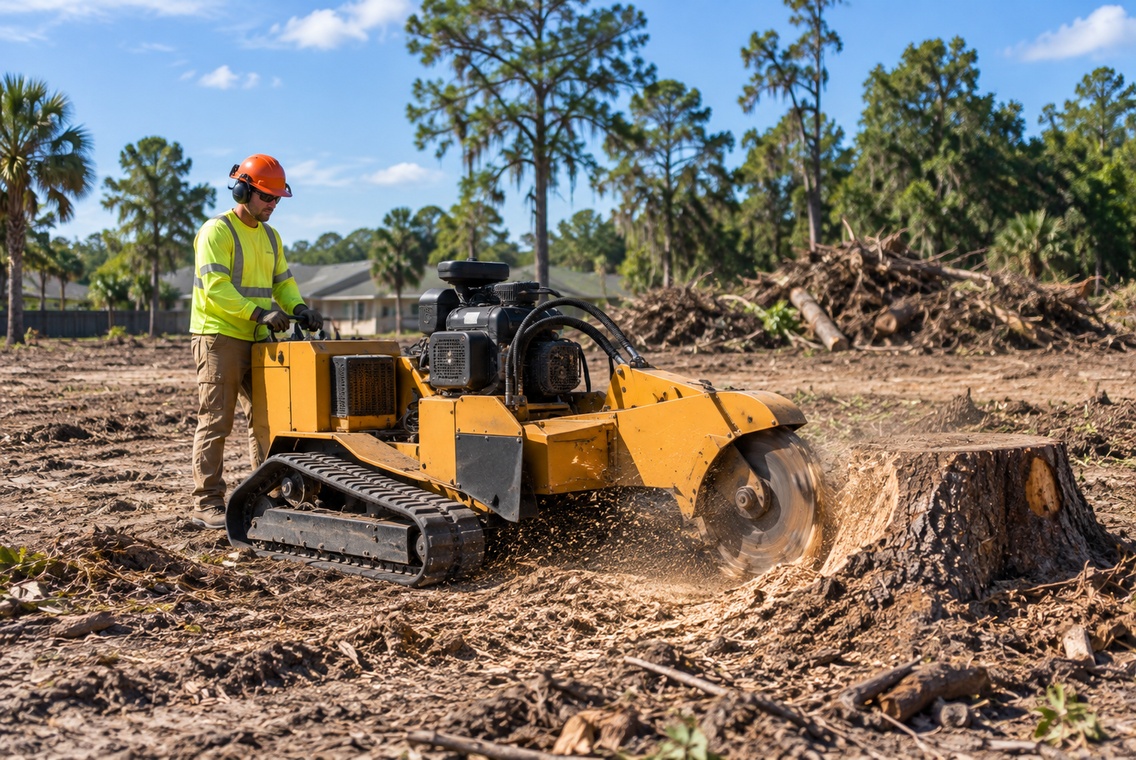
A cleared parcel with stumps and root balls still in the ground is not a buildable site. It is a site that looks clear from the road and will generate compaction failures and foundation problems once construction begins. If your Sanford property needs to go from cleared to pad-ready, call Drinkwater and Drinkwater at (407) 732-4530 or schedule the grinding and cleanup online.
Land clearing removes what is above the surface. Getting to a pad-ready site requires addressing what the clearing left behind: stumps, root balls, and buried organic debris that will compress, decompose, and create voids under any fill placed on top of them. Sanford developers and builders who move from clearing directly into grading without handling these subsurface remnants are building their schedule on ground that has not been properly prepared, and the consequences tend to show up at the worst possible time. Here is what the finishing phase of site preparation actually involves and why skipping it costs more than doing it right.
Wood is an organic material that decomposes over time, and decomposition produces volume loss. A stump or root ball left in place under a building pad or a paved surface will compress as it decays, creating differential settlement that the structure above it cannot accommodate without cracking, shifting, or losing the drainage grades that were established during grading. The timeline for that decomposition varies by species and soil conditions, but in Seminole County's climate, the process is active enough to create measurable settlement within the construction lifecycle of the structure being built above it.
Root systems extend significantly beyond the visible stump. A tree trunk at the surface has lateral roots that can extend outward a distance equal to or greater than the tree's height, and those roots decay on the same timeline as the stump. A site where stumps have been cut at grade but root systems remain intact has organic material spread across a much larger area than the stump locations suggest. Grading and compacting over that material does not eliminate it. It covers it and creates the conditions for differential settlement across the full root zone.
Compaction testing failures are the most immediate consequence builders encounter when organics are present in the subgrade. A proctor compaction test on fill placed over decomposing organic material will not achieve the density values the geotechnical report requires, because the material underneath is not stable enough to support the compactive effort applied at the surface. The fill compacts locally but the underlying organic material continues to compress under load. The result is a test failure that requires the organics to be removed and replaced with engineered fill, which is the excavation and replacement work that should have been done during site preparation rather than after grading was already complete.
We worked with a Sanford property owner who had cleared his land and was ready to move into construction, fully expecting the site to be buildable. When we assessed the site, the stumps and buried root balls he had not thought about were distributed across the footprint in ways that would have created compaction and settlement issues throughout the pad area. He had not realized that clearing and grubbing were separate operations, and that what he had was a cleared site rather than a grubbed one. Once we explained what the subsurface picture looked like and what it would mean for his foundation, the decision to handle it before vertical construction was straightforward.
On-site grinding is the most cost-effective approach for most Sanford commercial sites because it eliminates the haul-off volume that stump and debris removal would otherwise generate. A commercial-grade grinder processes stumps, root balls, and woody debris into chips that can be reused on-site as mulch for erosion control, incorporated into areas that will not be under impervious surface, or spread in buffer zones and landscaped areas. The grinding operation itself is faster than excavating and loading stumps for haul-off, and the reduced truck traffic during the finishing phase keeps the site moving efficiently.
Haul-off becomes the right choice when the volume of ground material exceeds what can be productively reused on-site, when the project's site plan does not include areas where mulch reuse is appropriate, or when the specification requires all organic material to leave the site footprint entirely. In those cases, grinding still reduces the volume of material that needs to leave because ground chips are denser and more compact to transport than whole stumps, which reduces the number of truck loads required and the associated haul-off cost per cubic yard of material removed. Either way, grinding is the front end of the process, and the haul-off or reuse decision follows from what the site's conditions and specifications require.
Ground mulch from a stump and debris grinding operation has productive uses on a commercial site that reduce disposal cost and provide genuine site benefits when it is placed correctly. Erosion control on disturbed slopes is the most common application during construction. Ground mulch spread across areas that have been graded but not yet stabilized with sod or seed reduces surface erosion during rain events, which is a stormwater compliance benefit as well as a practical one for maintaining the grades that were established during earthwork.
Buffer zones, landscaped areas, and the perimeters of wetland mitigation features are appropriate placement locations for ground mulch when those areas are included in the site plan. The material improves soil moisture retention, suppresses weed germination, and provides a finished appearance in non-impervious areas that requires minimal additional landscaping cost. The key constraint is that ground mulch from land clearing should not be placed in areas that will receive fill and be compacted, because the organic content it introduces into those areas creates the same compaction failure risk as leaving the original stumps in place.
When the project specifications require all organic material to leave the site, whether because the entire footprint will be under impervious surface or because the permit conditions prohibit on-site organic material disposal, the ground material is loaded and transported to an appropriate disposal or composting facility. Seminole County and the surrounding area have commercial composting operations that accept ground clearing material, and a contractor familiar with the region's disposal options can move material efficiently without the delays that come from searching for an available facility at the time of disposal.
A foundation schedule that begins on a site that has not been properly grubbed and finished is a schedule that is one compaction test failure away from a significant delay. The discovery that unsuitable organics are present under the building pad after grading is complete requires excavation, disposal of the unsuitable material, import of engineered fill, and recompaction in lifts before testing can be repeated. Each of those steps adds days to the schedule and cost to the project, and none of them was necessary if the site finishing work had been completed before grading began.
The protection that proper site finishing provides is primarily schedule certainty. A building pad placed on ground that has been grubbed, stumps ground or removed, and organic material addressed achieves compaction values on a predictable timeline because the subgrade is stable and consistent. The geotechnical engineer's representative can conduct testing with confidence that the results will reflect the actual bearing capacity of the prepared subgrade rather than the presence of decomposing material that the testing methodology was not designed to account for.
For Sanford developers working against a construction schedule with vertical trades lined up behind earthwork, that schedule certainty is not a minor benefit. It is what allows the foundation contractor to mobilize on the planned date, the concrete pour to proceed when the subgrade is certified, and the structural schedule to begin from the position it was planned rather than from a recovery position that compresses everything that follows.
If your Sanford site has been cleared and needs to be finished to pad-ready condition, call Drinkwater and Drinkwater at (407) 732-4530 or schedule the work online. Our land clearing and grinding operations are sequenced to deliver a site that is actually ready to build on, not just visually clear.

Copyright © 2023. All Rights Reserved.
Web Design, SEO & Hosting by REK Marketing & Design